The AI writes faster. Why do handovers take longer?
A customer needs an answer. An invoice needs checking. Your team wants to try a new tool. Start with a familiar problem, see what is happening, and choose what you would do. No technical background needed.
- Meet the problem
- See what is happening
- Make a choice
- Find out why
- Try a small change
All decisions are free without an account or API key. Drafts stay on this device only, not in account sync. Follow-up lessons retain their existing sign-in and plan requirements.
These are made-up (synthetic) stories with feedback written in advance, not live AI results or real customer outcomes. They help you practise, but do not certify your skills.
A volunteer kitchen wants help writing shift handovers. A coordinator suggests an AI drafting tool. Volunteers already have a paper form, and some find new screens harder to use than others.
The problem: The team needs clearer handovers with less total effort, not a rule that everyone must use a new tool.
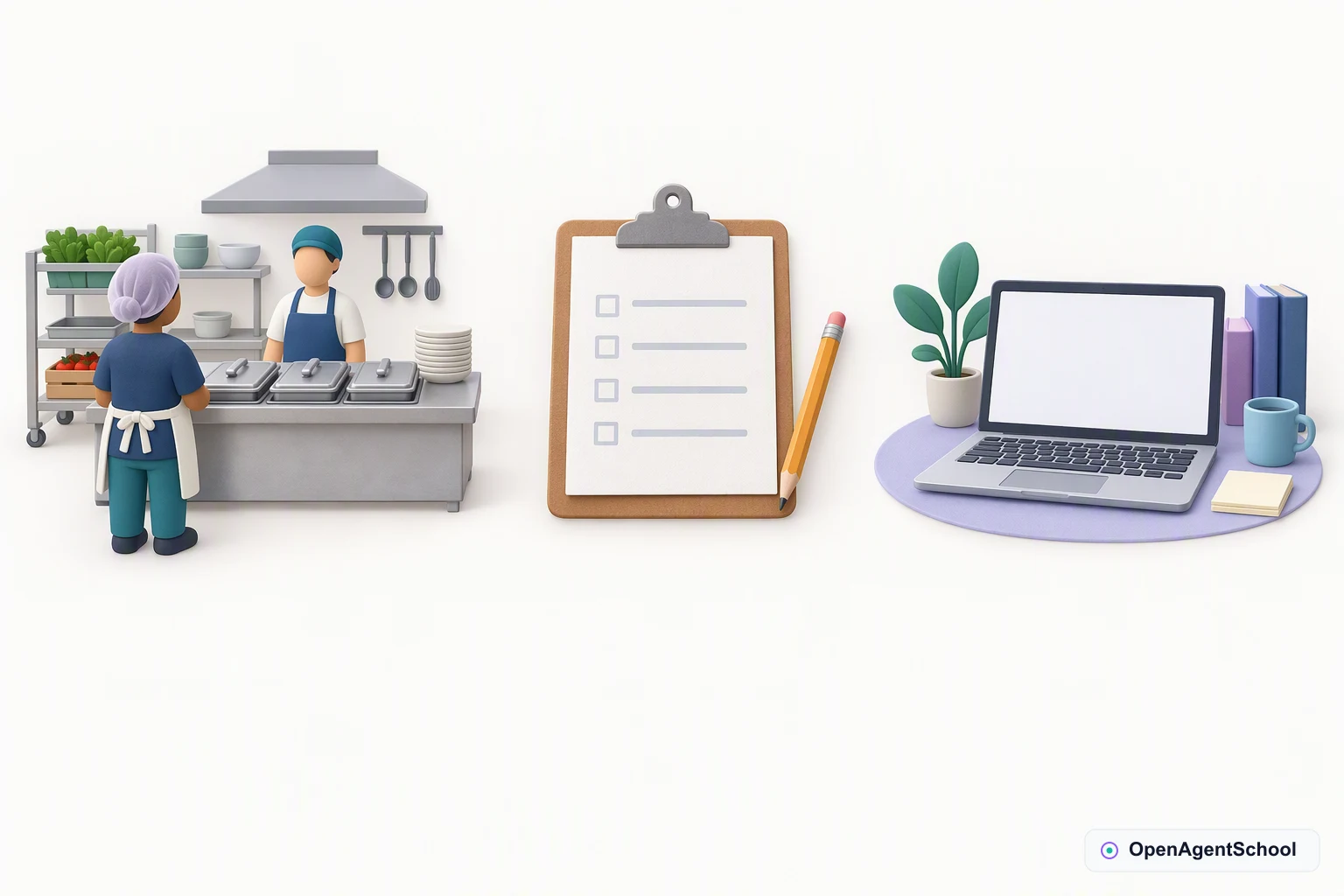
AI-illustrated teaching scene. Follow the arrows from 1 to 3; they show how to read the story, not actions taken by an AI.
- A new shift arrives
Volunteers need to know what is ready and what still needs doing.
- The current handover form
People already use a paper form to pass on important details.
- A proposed drafting helper
The coordinator wonders whether it will make handovers easier for everyone.
What would you do?
How should the coordinator try the idea?
- Ask everyone to use it at every shift
Why this choice?
That could spread extra work before anyone checks the benefit. Start with willing volunteers from different shifts and keep the existing option, rather than judging people by how often they use the tool.
- Offer a supported trial and compare complete handovers
Why this choice?
Count checking and correction time as well as typing saved. Invite different access needs, keep a comfortable way to decline and have people review notes before acting on them.
What to take away
Try the tool against real work, with a safe alternative. Using it more is not the same as being helped more.
What if something changes?
Volunteers say the helper writes quickly, but they spend longer correcting and copying its notes. The shifts use different headings, and one screen is difficult to navigate. A shared, accessible form could remove those problems without AI.
What should the coordinator do next?
- Fix the shared form and remove repeated copying
Why this choice?
That addresses the work people actually struggle with. Include all shifts and access needs, then compare the helper with the better form later; nobody should be blamed for reporting problems or choosing paper.
- Require more training before people can decline
Why this choice?
Training will not fix mismatched headings or repeated copying. Listen to the observed problems and improve how handovers work first, while keeping feedback separate from judgments about volunteers.
What to take away
When a trial reveals a simpler fix, use it. Do not turn a tool problem into a people problem.
The idea behind this story
Measure the whole job and change the process when that helps people more than expanding the tool.
What would you count besides typing time to know whether this helper really helps?
The technical connection: Outcome-based adoption
Measure task quality, total effort and accessibility against a baseline. Nonpunitive feedback guides rollout; tool-use counts must not become employee performance or employment decisions.
Advanced: A busy assistant is not an adopted improvement
Measure whether a team tool helps real work, then change course when corrections and duplicate entry outweigh the benefit.
Team change management and organizational adoption · 8 minutes
The problem
Synthetic practice scenario: all quantities and evaluation outcomes are illustrative, not reported research. Fictional outcomes are not guarantees. A team lead considers an AI handover helper for shift notes; the goal is fewer missed handoffs and less effort, not more tool usage or employee surveillance.
Your initial decision
How should the team learn whether a handover helper is worth adopting?
- The fictional team has 16 staff across shifts and an existing handover template with a known completion-time baseline.
- Volunteers can trial drafts with a manual alternative; staff review handovers before consequential operational action.
- Feedback must include different shifts and access needs, not only confident early adopters.
- Usage and feedback are for workflow improvement, not individual performance scoring, discipline or employment decisions.
Compare the alternatives
- Improve the existing handover template first
A clearer template may solve missing information at low cost, but the team has not yet established whether writing effort or template structure is the main obstacle.
- Launch across shifts with training and usage targets
A common launch offers shared support and consistent tooling, but participation targets can mask correction burden before the team knows whether the helper helps.
- Run a supported volunteer pilot against the baseline
A small trial measures total handover work and missed details with staff feedback, but needs coverage across shifts and cannot represent everyone automatically.
Mechanism, trade-offs, and evidence
- Define success as useful completed handovers, including review and correction time, rather than drafts generated or sessions opened.
- Invite different working conditions into the trial and provide support so a usability obstacle is not mistaken for resistance to change.
- Keep employee evaluation out of the experiment; honest feedback becomes less likely if trying or rejecting the tool affects employment judgments.
Reconsider after a change
The pilot saves typing but adds correction and duplicate-entry work; observations show the deeper issue is inconsistent handover fields between shifts, not lack of drafting skill.
What should the team change before asking more colleagues to adopt the helper?
- An illustrative independent work sample shows 4 minutes saved typing but 6 extra minutes correcting and copying each handover: a net increase of 2 minutes.
- Night-shift staff identify missing ownership fields and a screen-reader obstacle that the initial volunteer group did not reveal.
- The team can agree a shared handover form and remove duplicate entry without using a model.
- Staff feedback remains nonpunitive; no one is labeled uncooperative or evaluated for choosing the manual route.
Compare the alternatives
- Fix shared fields and duplicate entry before expansion
A workflow repair postpones wider AI use while addressing measured overhead and accessibility gaps that more generated drafts would not solve.
- Expand the launch with more drafting training
Extra training can help people use a tool, but it cannot remove duplicate systems or missing handover ownership and may spread the observed extra work.
- Keep a small optional pilot for unresolved drafting tasks
A narrowly focused trial could answer remaining questions, but needs a distinct task and must not distract from the shared workflow repair.
Mechanism, trade-offs, and evidence
- Count all the work: saving typing while adding more correction is a loss here, not a successful pilot with an adoption problem.
- The new evidence points to process and accessibility changes; simplifying is a positive outcome when it improves real work.
- After fixing the baseline, reassess specific drafting needs with representative staff rather than preserving the original tool decision for its own sake.
Related technical concepts
Follow-up lessons retain their existing sign-in and plan requirements.
Technical sources
- AI Risk Management Framework — NIST
Organizes voluntary risk management around governing, mapping, measuring and managing; it is neither certification nor a return-on-investment study.
- Building effective agents — Anthropic Engineering
Distinguishes fixed workflows from model-directed agents and recommends testing simpler solutions first; its tooling examples are historical.
- Demystifying evals for AI agents — Anthropic Engineering
Explains tasks, graders, repeated trials and outcome evaluation for agents; use task-specific tests rather than importing reported scores.
Learning together? Pick a story, compare your choices, and talk about what might change your mind. There are no verified team scores or completion records here.
Self-checks and completion records help you reflect; they are not independently verified credentials. Credential availability, assessment, and eligibility are separate.
AI Agents, Explained — free, no login
Explore the cases
- Can I return these shoes?
- The refund screen froze. Did the money move?
- The AI fixed Save. Can we put it live?
- The shop website will not take orders
- We both said approved supplier. Did we mean the same thing?
- It gets the same ten questions right. Is it ready?
- How do I book an appointment on a noisy bus?
- We can improve one task. Which one is worth our time?
- It is your first day at the garden. Where do you start?
- Can the helper pay this repair bill?
- Can we sign the room booking agreement today?
- The caterers sent their prices. Are we comparing the same thing?
- A customer wants a cake by Saturday. Can we promise it?
- Should our shopping helper reorder the household supplies?
- Can we put the neighbors' feedback into an AI tool?
- A volunteer needs the event plans. Which folders should they see?
- These club files are old. Can we delete them?
- There is a new AI helper. Should the club switch?
- Our online helper is down. How can we help visitors?
- The AI writes faster. Why do handovers take longer?